Sustainability

The Medium-term Management Plan - FY25–FY27 - (the “Medium-term Plan”) aims to rebuild and strengthen profitability through three company-wide strategies—“Thorough Selection and Concentration,” “Creation of New Value,” and “Promotion of Global Strategy.” In FY2025, the first year of the plan, these initiatives produced results at a faster pace than anticipated.
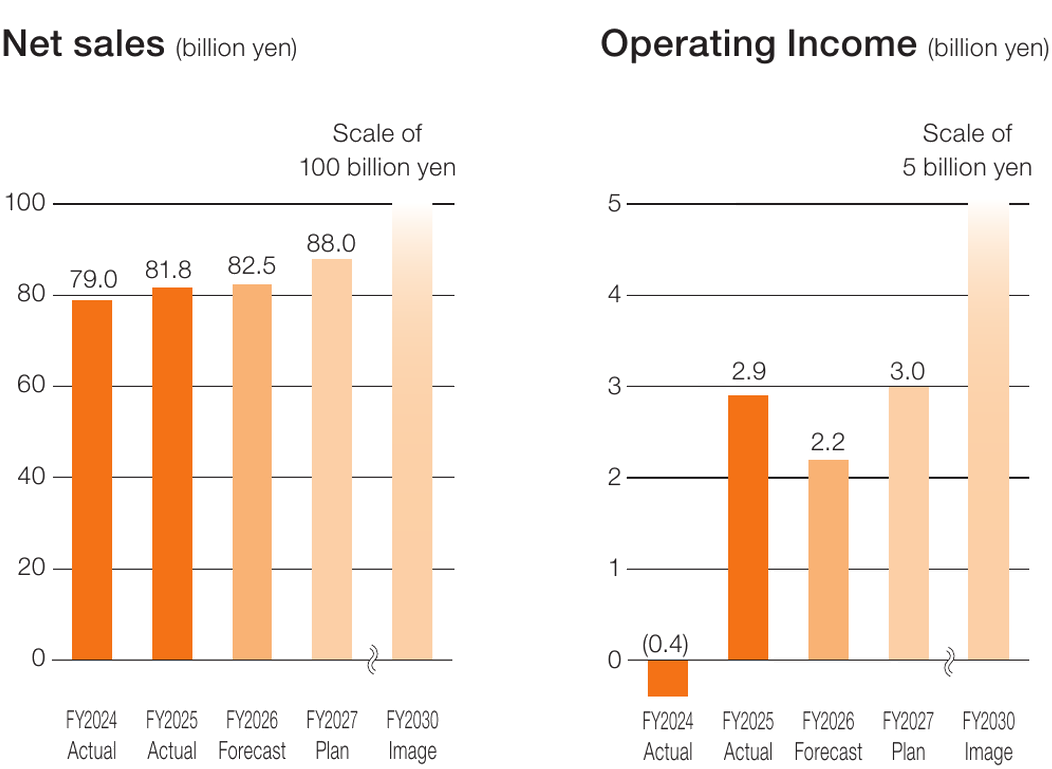
For FY2025, consolidated net sales were 81.8 billion yen (up 3.4% year on year), operating income was 2.9 billion yen (compared with an operating loss of 0.4 billion yen in the previous year), ordinary income was 3.9 billion yen (compared with an ordinary loss of 0.2 billion yen in the previous year), and profit attributable to owners of parent was 2.1 billion yen (up 394.7% year on year), representing a substantial improvement in earnings. Overseas net sales also increased significantly to 21.4 billion yen (up 24.4% year on year), while the operating income margin was 3.6% and ROE was 5.1%. With an operating income target of 3.0 billion yen for FY2027, the final year of the Medium-term Plan, we believe we made an extremely strong start by coming close to that target in the very first year.
The biggest factor behind this dramatic improvement in profitability was the increase in gross profit margin achieved through “Thorough Selection and Concentration.” Since the business organization was restructured last year, we have concentrated management resources on focus areas expected to offer growth and profitability. As a result, sales increased substantially for films used in the medical field, where demand is expanding in manufacturing processes for antibody drugs and vaccines, as well as for materials used to transport semiconductor wafers and in manufacturing processes in the electronics field, which is booming on the back of AI demand. Our strengths in materials control technology and electrostatic and clean technologies were fully demonstrated, and highly profitable businesses, including those overseas, strongly drove the Company’s overall performance.
At the same time, we have steadily advanced initiatives to resolve issues in business areas that require structural reform. In the Shoes Business, we made improved profitability our top priority and decisively implemented our “4P Strategy,” including withdrawal from unprofitable areas and a sharper focus on high-value-added products. Although net sales declined, we were able to reduce the operating loss by approximately 0.6 billion yen year on year. In the Automotive Materials Business, while optimizing the business structure in light of developments in the Chinese market, we also promoted a shift toward growth fields by expanding sales of highly flame-retardant products for aircraft, primarily in North America. In the Disaster Response Business, we recorded an impairment loss of approximately 0.9 billion yen due to delays relative to the assumed plan, but we regard this as part of a sound restructuring process to create a leaner business structure that can generate profits more readily.

A robust business foundation is indispensable to steadily advance our company-wide strategies and achieve sustainable growth. In particular, the “Production Solutions Division,” “Innovation Technology Division,” and “Office Center,” which were newly established in the Production Div. last year, have begun to function effectively, and the advancement of our business foundation is progressing through multifaceted approaches.
Although we achieved a steady recovery in business performance, we recognize that the current business environment cannot be viewed optimistically in light of geopolitical risks. The heightened tensions in the Middle East could have a major impact on raw material procurement and energy costs for us, as plastics derived from naphtha are a main raw material. To overcome this situation, on the procurement front we are working to build a flexible supply structure by deepening collaboration with suppliers, diversifying procurement sources, and making use of alternative materials. On the cost front, while seeking to revise product prices to appropriate levels based on careful explanations to customers, we are also advancing in-house cost reduction initiatives, such as reducing material and energy costs through consolidated production, thereby strengthening our resilience to risk.
Our consolidated earnings forecast for FY2026, announced on May 12, 2026, calls for net sales of 82.5 billion yen, operating income of 2.2 billion yen, ordinary income of 2.0 billion yen, and profit attributable to owners of parent of 1.3 billion yen, representing an increase in sales but a decrease in profits. The forecast reflects the costs of “strategic upfront investments,” including capital investment linked to future growth, the promotion of human capital management, and DX investment; however, it is overall a cautious and sound plan in light of the increasingly uncertain business environment. The impact of the situation in the Middle East has not been incorporated because it is difficult to estimate reasonably, but we will strive to exceed the plan through cost reduction initiatives, appropriate sales price revisions, and other measures.
The top priority of sustainability management for the Achilles Group is to improve profitability and establish a firm path toward sustainable growth, and the foundation for this lies in our corporate philosophy of “Living with Society.”
With regard to climate change, we continue disclosure based on the TCFD recommendations and are advancing energy-saving measures, including capital investment at factories and real-time management of electricity, toward our target of “reducing the combined Scope 1 and Scope 2 emissions by 50% by the end of 2030 compared with FY2018.”
We also continue to conduct regular surveys and take appropriate action regarding human rights risks, including throughout the entire supply chain.
We are convinced that initiatives for ESG (environmental, social, and governance) are “investments in the future” that will create sustainable growth and new earnings opportunities. For example, stricter energy-saving regulations aimed at realizing a decarbonized society will also lead to increased demand for our “high-performance thermal insulation materials.” In response to the social issue of extreme summer heat, we developed the heat-shielding product “Achilles Solar Clear,” which combines comfort with energy conservation, and opened up a new market. The essence of the sustainability management we aim for is to solve society’s “problems” with our technologies and establish those solutions as new businesses.
The environment surrounding companies is shifting from the VUCA era of increasing uncertainty to a chaotic era (BANI), in which complex changes in people’s emotions and values are also a factor. To achieve sustainable growth in such an era, organizational capabilities that can respond quickly and flexibly to change, together with the diverse human resources that support them, are indispensable.
Through the Medium-term Plan, we are regaining our “earning power.” Without stopping this progress, we will continue to make stable and consistent dividends our basic policy while also considering flexible shareholder returns such as acquisition of treasury shares, and will devote ourselves to improving capital efficiency and maximizing corporate value.
On the global stage, creating and delivering new value unique to Achilles will hopefully bring smiles to our customers. And we want to remain a corporate group in which that joy is shared with our employees and smiles naturally spread throughout the organization. Please look forward to Achilles’ challenges on a new stage toward realizing “Vision 2030.”

September 2026
Refer to the following for details on Achilles Group’s medium-term management plan.

